SpaceX Launches its Biggest Rocket Yet: The IPO
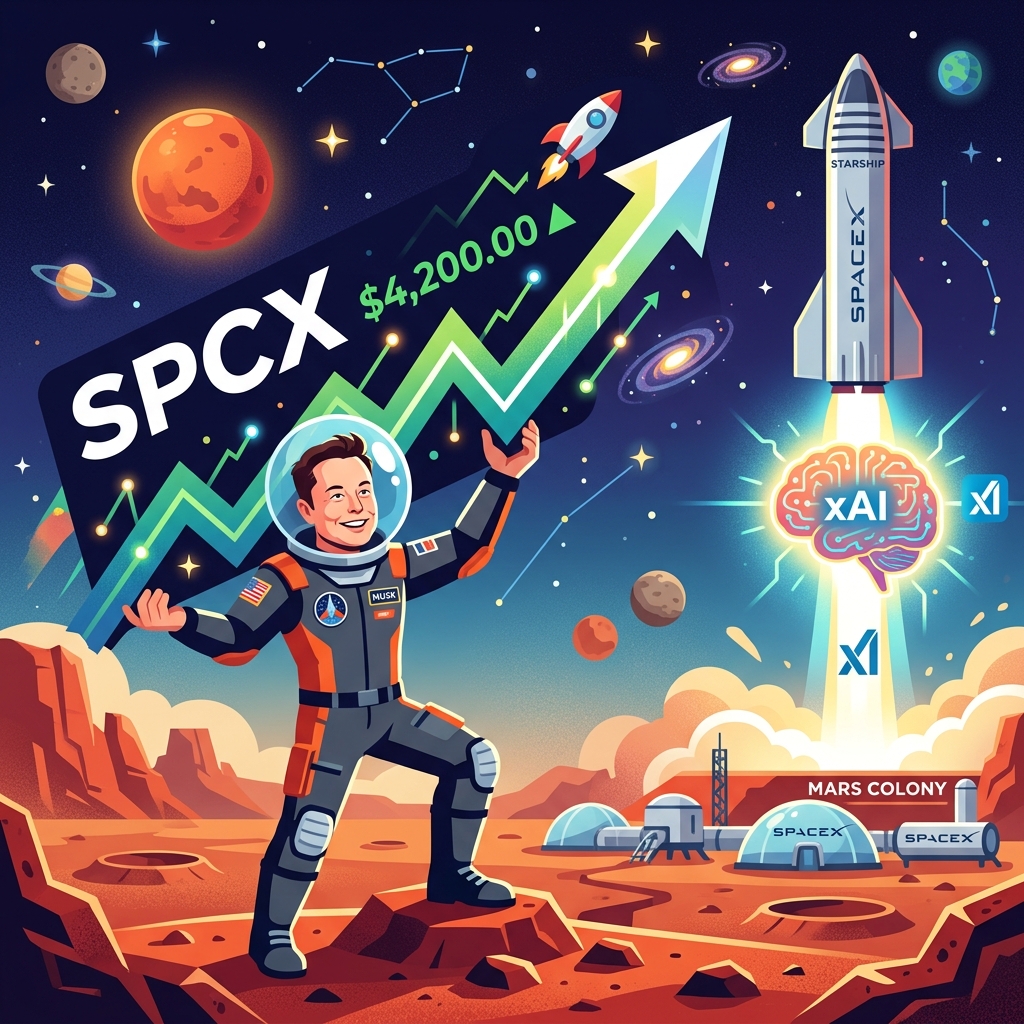
If you thought Elon Musk's tens-of-billions compensation package at Tesla was mind-blowing, he is here to tell you: "Earth money is boring. Let's bet the entire company on a Mars colony!"
"When you trade shares of 'SPCX' on Nasdaq in the future, remember: you are not buying a rocket company or a satellite internet provider. You are buying a cosmic bundle of space-based AI, a future empire of a million Martian citizens, and the most audacious stock option package in history."
The $2 Trillion Behemoth: "SPCX" Files for IPO
On May 20, 2026, SpaceX formally filed its Form S-1 prospectus with the U.S. Securities and Exchange Commission (SEC), starting what promises to be the most ambitious IPO in human history.
Planning to list under the ticker symbol "SPCX" on both the Nasdaq and the newly established Nasdaq Texas, the target valuation is set between $1.75 trillion and $2 trillion. If successful, Musk will hold the reins of two trillion-dollar public companies, solidifying his spot as the world's first trillionaire.
The xAI Merger: Connecting Data, Compute, and Rockets
The prospectus officially confirms a major restructuring: SpaceX completed its acquisition and merger of xAI on February 2, 2026.
The combined entity now has three key business segments, realizing Musk's vision of a closed-loop system spanning "Data (X) -> Model (Grok) -> Compute (Colossus) -> Communication (Starlink) -> Vehicle (Starship)":
- Space Segment: The launch division. Falcon 9 rockets are now certified for up to 34 reuses, while the Starship V3 configuration (B19 booster + S39 ship) prepares for Flight 12 on May 22, 2026.
- Connectivity Segment (Starlink): The cash cow. Starlink generated $11.38 billion in revenue and $4.42 billion in operating profit in 2025, serving over 10.3 million subscribers across 164 countries.
- AI Segment (xAI): Home to the Colossus supercomputer clusters (1GW capacity). While operating at a loss, SpaceX just locked in a historic 3-year, $45 billion compute leasing deal with Anthropic.
The Ultimate Bet: Vesting on Mars
In typical Musk fashion, his performance-based equity package granted in January 2026 (consisting of 1 billion shares) has a single, cosmic vesting condition: establishing a permanent human colony on Mars with at least 1 million citizens.
If the Martian city isn't built, Musk gets absolutely nothing from this package, regardless of how high the stock price flies on Earth. It is the ultimate skin-in-the-game bet for a multi-planetary future.
Orbital Compute: Grok in Space
Looking ahead, SpaceX plans to launch its first **orbital AI compute satellites by 2028**. By utilizing free solar energy and radiative cooling in space, the company aims to host AI models directly in Earth orbit via the Starlink constellation. They have already applied to the FCC for the launch of up to 1 million computing satellites.
Conclusion
Investing in SPCX isn't just about buying shares; it's buying an boarding pass to the stars. If it succeeds, it will be the dawn of the space age; if it fails, it will be the most expensive PowerPoint presentation in human history.